Grid Reliability: A Quiet Engine Behind Energy’s M&A Boom
Regulation, not just demand, is turning a fragmented niche into one of the hottest segments in energy services M&A.
Most of the conversation around the U.S. power buildout is focused on data centers, gigawatts and generation. But as detailed in the Transmission and Distribution section of our 2026 Energy and Power Overview, one of the most durable investment opportunities in the sector isn’t as much about building new capacity. It's in keeping the grid that already exists safe, compliant and running. Grid reliability and electrical infrastructure services span from transmission interconnection and support, power systems engineering, protective relay and switchgear testing, all the way to electrical field services, and they have quietly become one of the most active segments in energy services investment today.
The reason isn't just aging infrastructure or rising load. It’s regulation, and regulation moves on its own clock.
The Regulatory Floor is Rising
Two actions taken in 2024 reshaped the demand picture for this work. FERC Order No. 1920, issued in May 2024, requires every transmission provider to run comprehensive 20-year forward-looking planning assessments every five years, explicitly factoring in extreme weather, aging infrastructure replacement and shifting load profiles. The order's reach was extended through Order No. 1920-A in November 2024, and Order No. 1920-B in April 2025, both of which expanded the role state regulators play in deciding how the costs of new transmission facilities are allocated.
Separately, NERC's Extreme Cold Weather Preparedness standard, EOP-012-2, took effect in October 2024 and has since been superseded by EOP-012-3, effective October 2025. Both require generator owners across the bulk electric system to implement and document certified freeze-protection plans — a direct response to the cascading failures of Winter Storm Uri and Winter Storm Elliott. In December 2024, NERC's Board of Trustees went a step further, approving TPL-008-1, the first reliability standard built specifically around extreme temperature planning for transmission. It calls for benchmark stress assessments every five years and took effect April 1, 2026.
Individually, these are compliance mandates. Together, they create something more valuable to investors: a demand floor for engineering studies, grid assessments and infrastructure upgrades that exists independent of any single utility's discretionary capital budget. By mid-2025, 14 states had already enacted legislation requiring utilities to evaluate grid-enhancing technologies in planning or investment filings, a trend Order 1920 is likely to continue to accelerate.
At the federal and state level, FERC, NERC and state public utility commissions are tightening reliability requirements through mandatory programs and rate-case approvals, adding compliance-driven layers to each investment case.
The result is a broad-based acceleration in spending across three key areas:
- Grid reliability and electrical infrastructure services
- Storm hardening and physical grid resilience
- Distributed energy and grid-edge solutions (with contributions from building-level efficiency)
— FMI 2026 Energy and Power Overview
For service providers, this is the difference between chasing project-based work and owning recurring, compliance mandated revenue that shows up, regardless of whether a utility's broader capital expenditure (capex) plan gets approved. That’s a distinction worth sitting with because it’s the source of everything that follows.
Fragmentation Meets a Capital Wave
The market delivering this work looks nothing like the concentrated, brand-name landscape forming around it. It remains highly fragmented, populated largely by regional technical service providers. That fragmentation, paired with a compliance-driven revenue base that both strategic and financial buyers find attractive, has drawn a wave of sponsor capital.
Blackstone's acquisition of Shermco Industries, and Kohlberg's acquisition from Investcorp of RESA Power in 2025, are examples of large-cap sponsors staking out platform positions, with Clearlake, TJC and CBRE among others building similar footprints through steady acquisition. Pricing reflects the interest: diversified platforms in 2025 and 2026 deals have commanded all-time highs in market pricing, while single service or state providers generally trade at a discount to the platform premiums, albeit still at all-time highs for their segment. That gap is precisely the arbitrage that platform strategies are built to exploit, and it only exists because the underlying revenue is primarily regulatory driven.
A Familiar Playbook, Running Faster
The growth model here follows a pattern that buyers in fragmented services markets will recognize: acquire a regional platform, layer in adjacent capabilities and scale nationally. What's changed is the pace and the price. As scaled platform assets become scarcer, more sponsors are choosing to build from scratch rather than pay up for existing scale — a dynamic reflected in FMI's own transaction history in the space.
The deal activity is substantial, and it’s a useful signal. But it’s also an effect of the actual story. FERC and NERC aren’t finished raising the compliance floor. TPL-008-1 took effect April 1, 2026, and additional extreme-weather planning standards are still moving through the pipeline. This means the regulatory tailwind behind this sector isn’t a one-time catalyst, it’s a sustained driver of durable demand.
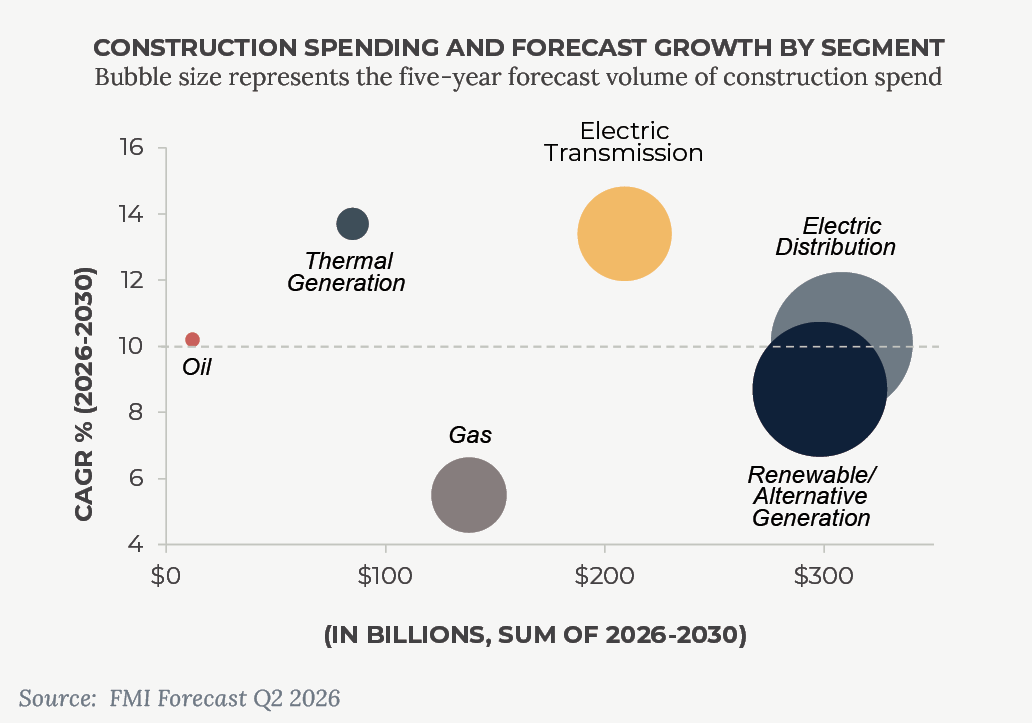
For business owners, that long-term driver is what makes now a favorable time to evaluate options. For acquirers, it’s what should separate a genuinely defensible platform from one simply riding a hot market: the ability to convert compliance-driven revenue into technical capability that outlasts the current cycle. To learn more about grid reliability services and the $1 trillion U.S. power construction spending projected through 2030, read our full report: FMI 2026 Energy and Power Overview.
Connect With Our Energy and Power Team:
Russell Clarke — Managing Director, FMI Capital Advisors [email protected]
Andrew Henderson — Managing Director, FMI Capital Advisors [email protected]
Blake Angelo — Partner, FMI Consulting [email protected]
Evan Fairmont — Partner, FMI Consulting [email protected]