Growth Exposes What Talent Strategy Was Supposed to Prevent

Most CEOs can tell you their backlog. Few can tell you their HR-to-employee ratio, and that gap is often the first sign their talent strategy has already fallen behind.
In our previous article, Why Your Talent Leader Is Failing, we challenged a common assumption: when a talent leader struggles, the problem is often not the individual, it’s the environment surrounding the role. Organizations frequently assume they hired the wrong executive when in reality they haven’t created the conditions necessary for that executive to succeed.
That insight raises a very important question for CEOs:
How do you know whether your organization is prepared to execute the talent strategy your business strategy requires?
The answer has less to do with hiring exceptional talent and more to do with understanding whether your organization’s capabilities have matured alongside its business. This is where talent strategy becomes a business issue and not simply an HR issue.
Every business strategy carries an implicit talent strategy. Expanding into new markets, growing backlog, acquiring companies, increasing self-perform work, and developing future leaders. Each goal assumes the organization has the recruiting capability, leadership capacity, workforce planning, and the organizational infrastructure required to deliver it.
When those capabilities fail to keep pace with business growth, organizations rarely feel the impact immediately. Instead, it surfaces through slower hiring, project staffing challenges, leadership bottlenecks, avoidable turnover, delayed integrations and increasing execution risk.
One Metric Worth Every CEO’s Attention
While no single metric captures a company’s readiness to grow, the HR-to-Employee ratio is one of the fastest indicators of whether talent infrastructure is keeping pace with organizational growth. Firms operating well beyond appropriate staffing ratios frequently expect a small HR team to simultaneously recruit, onboard, develop leaders, manage compliance, support operations, build success plans, and drive cultural transformation. And when the HR team fails to meet such outsized expectations, it’s not a talent problem, it’s a growth problem, showing up as missed and slow hires, thin succession benches, and turnover in roles the business can least afford to lose.
Most general HR benchmarks (SHRM, ADP, Gartner) put the average talent leader to employee ratio across all industries somewhere between 1:60 and 1:100. But those numbers are built on white-collar, professional-services populations. Construction and other field-heavy industries have always run structurally leaner, and for good reason: a superintendent managing 40 craft workers on a jobsite doesn't require the same HR support as 40 knowledge workers in an office. The AEC-specific ratios matter because applying a generic benchmark to a contractor will always make the talent function look understaffed when it may simply be structured differently.
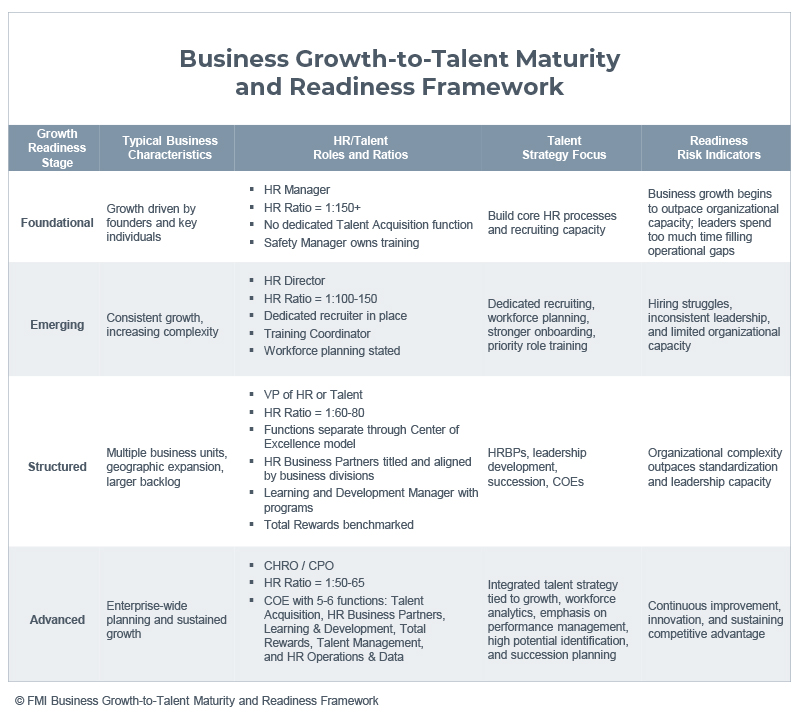
Even so, the ratio itself is not the answer, it is an early indicator that business complexity may be outpacing organizational capability. To illustrate this, let’s view talent capability through a maturity and growth readiness framework in the table below. This framework reflects how organizations evolve as they scale from the stages of Foundational to Emerging, Structured to Advanced. The organization’s goal is not to necessarily reach the final stage as quickly as possible. It’s to ensure the talent function is appropriately aligned with the organization’s current size, complexity and growth strategy.
The greatest risk is not operating at a Foundational level, but rather believing your organization has advanced further than its systems, processes, leadership capacity, and talent infrastructure can effectively support. This misalignment creates unrealistic expectations, leadership frustrations, lack of or misdirected investments, and unnecessary execution risk. And when the HR team fails to meet such outsized expectations, it’s not a talent problem. It’s a growth problem, manifesting in the form of missed hires, slow hiring, thin succession benches, and turnover in the roles the business can least afford to lose.
The framework below maps talent maturity against the stages of business growth. Locate where your organization sits today, then compare it to where your growth plan is taking you.
Spend & ROI
Talent development spend is instructive here too. The 2026 Association for Talent Development (ATD) State of the Industry report puts average direct learning expenditure at roughly $846 per employee annually, or about 0.9% of payroll. That's the general market. Contractors investing meaningfully below that line aren't being lean, they're often just deferring the cost. It shows up later as slower PM readiness, project delivery risk, and higher reliance on external hiring.
It's worth noting that AEC-specific benchmarking data is scarce. Most published HR research treats construction as a footnote inside broader "low-HR-intensity" industry categories, alongside manufacturing and logistics. That gap is not an accident. Talent infrastructure has historically been an afterthought in an industry built around estimating, scheduling, and field execution. The absence of AEC benchmarks is itself evidence of the underinvestment this article is describing.
CEOs that intentionally mature their talent function create measurable business value through improving hiring velocity, shorter time-to-productivity, strengthening leadership pipelines, retaining critical talent, reducing dependency on reactive recruiting, improving succession readiness, and enabling more predictable execution. Those outcomes translate directly into concrete ROI, greater organizational resilience, and stronger long-term performance. This framework should be viewed as a guide to strategic investment in enterprise capability and not simply an increase in HR cost.
Understand the Journey You’re Asking the Talent Executive to Lead
One of the most common misconceptions is that hiring a highly capable talent executive will, by itself, solve organizational capability gaps. In reality, exceptional talent leaders often accelerate transformation but only when the organization understands the transformation it is asking them to lead.
If the business is operating at a Foundational level, the talent executive’s first priorities may have little to do with leadership development or strategic workforce planning. Instead, they may need to build recruiting processes, clarify organizational structure, establish workforce data, implement HR systems, create management practices and earn credibility across the business.
None of this means hiring an exceptional talent executive is the wrong decision. In many cases, it’s exactly the right decision, depending on the expectations set around the hire. CEOs who understand their organization’s maturity and readiness stage are better equipped to define the assignment clearly:
- Are we hiring someone to optimize an established function?
- Or are we hiring someone to build that function from scratch?
Both are strategic leadership roles, but they require different success measures, different investment levels, and different timelines to complete the mission.
Is Your Organization Ready for a Readiness Check? The Executive Call to Action
Before the next strategic planning discussion, executive teams should ask:
- Is our talent capability keeping pace with our business strategy?
- Are we investing in organizational capacity before growth exposes structural gaps?
- If our growth plan succeeds, can our current talent infrastructure realistically support it?
- Does our HR-to-Employee ratio align with the staffing benchmarks for our size and growth stage, or have we already outpaced it?
- Do we have read-now successors for our most business-critical roles, or would a single departure stall execution?
If your answer to any of these questions is, “no” or “I’m not sure,” your next step isn’t to rethink your talent leader, it’s to assess your organization’s Talent Maturity and Growth Readiness. Understanding where your organization sits today provides the foundation for making smarter investments, setting realistic expectations, and aligning talent strategy with business strategy. Sustainable growth depends on both advancing together. Organizations that intentionally build talent capability alongside business growth reduce execution risk, strengthen their competitive advantage, and develop the leadership capacity required to sustain long-term success.
Connect with our Leadership Team:
Laurie Addison – Senior Consultant, FMI Consulting [email protected]
Hannah Flint – Principal, FMI Consulting [email protected]